Yangwang U9 Xtreme: 503.17 km/h — Fastest Hypercar on the Planet 🏎️
6 Nov 2026
Quick takeaway ⚡
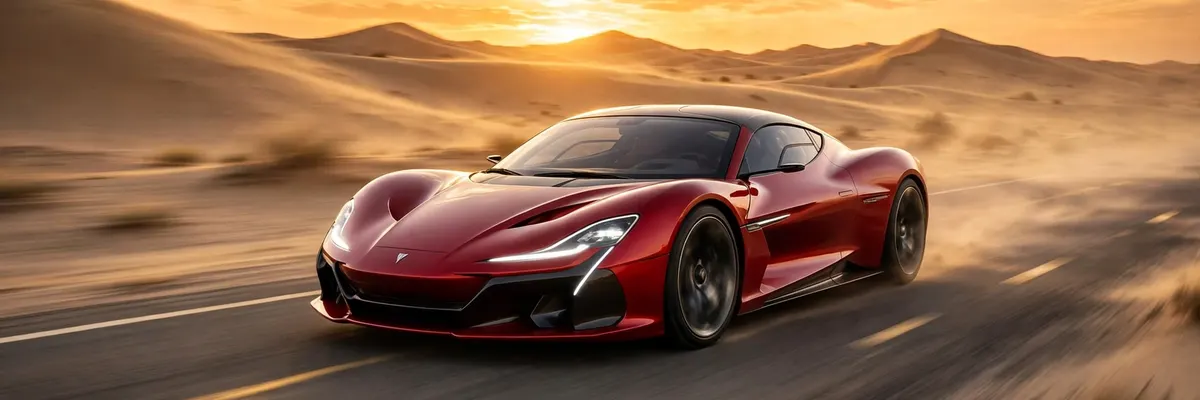
The Yangwang U9 Xtreme is BYD's track-focused electric hypercar, and on 1 November 2026 it became the fastest production car on the planet: 503.17 km/h (312.66 mph) on a closed stretch of the E11 highway in Abu Dhabi, with German racing driver Marc Basseng at the wheel. The run was recognised by the FIA and earned two Guinness World Records — the highest speed by a production car and by an electric production car in a single-direction run — making the Yangwang U9 Xtreme the first production car ever to pass 500 km/h. The car that did it is not a concept or a one-off: BYD is building 30 of them, at a reported price of around $3 million each, which converts to roughly Rs 83 crore before any import duties. This guide suits anyone who loves cars, speed or electric power, and anyone wondering whether the record is real and what it actually means. It is not a buying guide, because you cannot buy this car in Pakistan — there is no launch plan, and Yangwang is not sold here. And if the number you care about is a two-way average rather than a one-way peak, the honest answer is that the SSC Tuatara still holds that record at 455.3 km/h. Read on for how the run happened, what the car is made of, and how it stacks up against Bugatti, Rimac and Koenigsegg.
What is the Yangwang U9 Xtreme? 🏎️
The Yangwang U9 Xtreme is the track version of the Yangwang U9, the flagship supercar of Yangwang, BYD's luxury performance brand. The standard U9 went on sale in China in February 2024 with four motors making 960 kW (1,287 hp) and a top speed of 309.19 km/h, at CNY 1.8 million — about $250,000. The Xtreme takes the same idea and turns every number up: four motors at 555 kW each, 2,220 kW in total, a 1,200-volt electrical system, a track-grade Blade Battery, and bodywork shaped for life above 400 km/h. BYD showed the car to the world on 20 September 2025 and opened pre-orders the same day, then unveiled the production version at the Beijing Auto Show in April 2026, where one car sold for more than CNY 20 million. Only 30 will be built, and they are sold by invitation in China. The Yangwang U9 Xtreme is not a road car with a big engine: it is a purpose-built speed machine, with active body control, carbon-ceramic brakes and tyres made for one job — staying glued to the road at speeds where a normal tyre would come apart. It also holds the production EV lap record at the Nürburgring Nordschleife, at 6 minutes 59.157 seconds, so it is not only fast in a straight line.
How it hit 503.17 km/h 🛣️
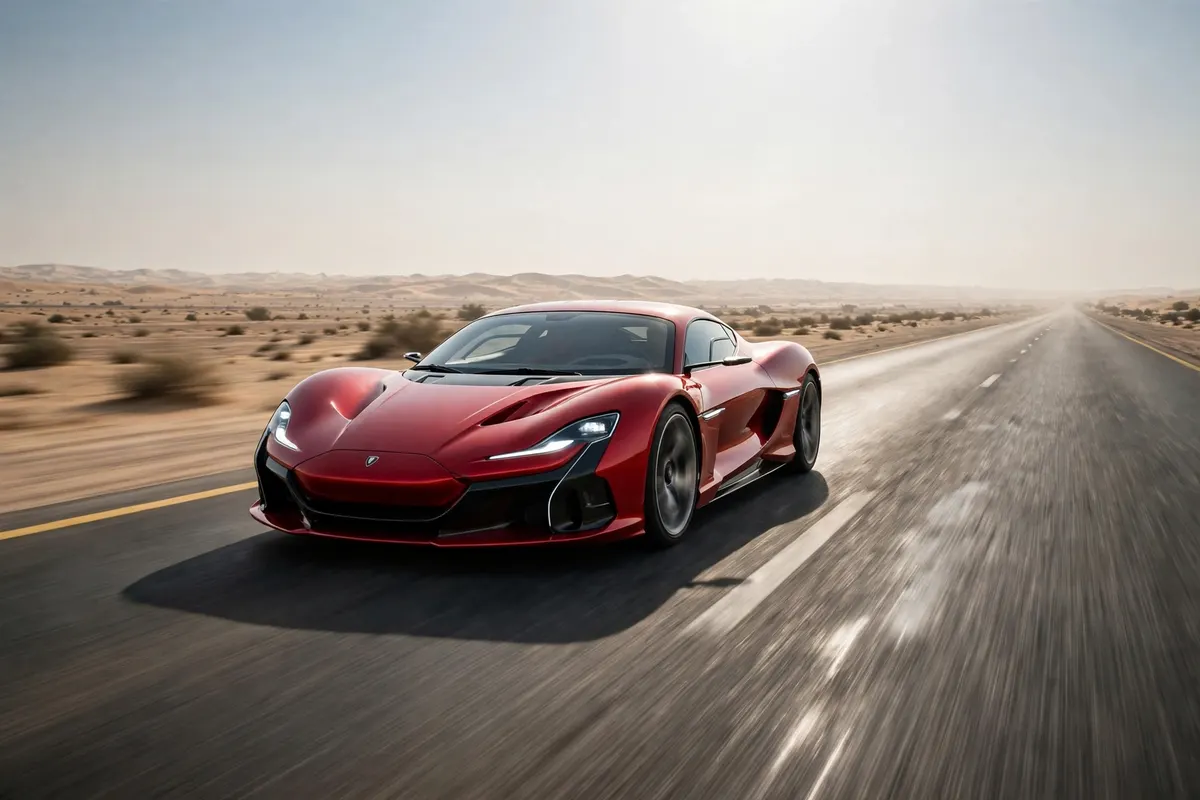
The record was set on the Sheikh Khalifa bin Zayed International Road — the E11 — in Abu Dhabi's Al Dhafra region, on Sunday 1 November 2026. Abu Dhabi's authorities closed a 10-kilometre stretch of the highway and gave the team a 7-kilometre straight, after crews cleared the road of stray wire fragments that could have damaged the tyres at that speed. German racing driver Marc Basseng, who had set the car's previous record in Germany, was behind the wheel for four runs over two days. On the first day, 31 October, the car topped out at 490 km/h. That was already faster than any Bugatti had ever gone, but the team wanted more, so engineers worked overnight on battery and motor temperatures, the rear-wing angle, the rebound damping and the tyre pressures. On the second day, Basseng went faster on the first run, then hit 503.17 km/h on the second — measured by a Racelogic recorder and recognised by the FIA, which announced the record on 6 November. Onboard footage tells its own story: Basseng held only 50 to 60 percent throttle until 236 mph (about 380 km/h), and only then went flat out. The car had more to give at the point most cars are already at their limit. One detail matters for the record books: the run was in one direction only. The two Guinness records it earned are both for a single-direction run, and BYD chose not to set a two-way average.
Yangwang U9 Xtreme specs and price 💰
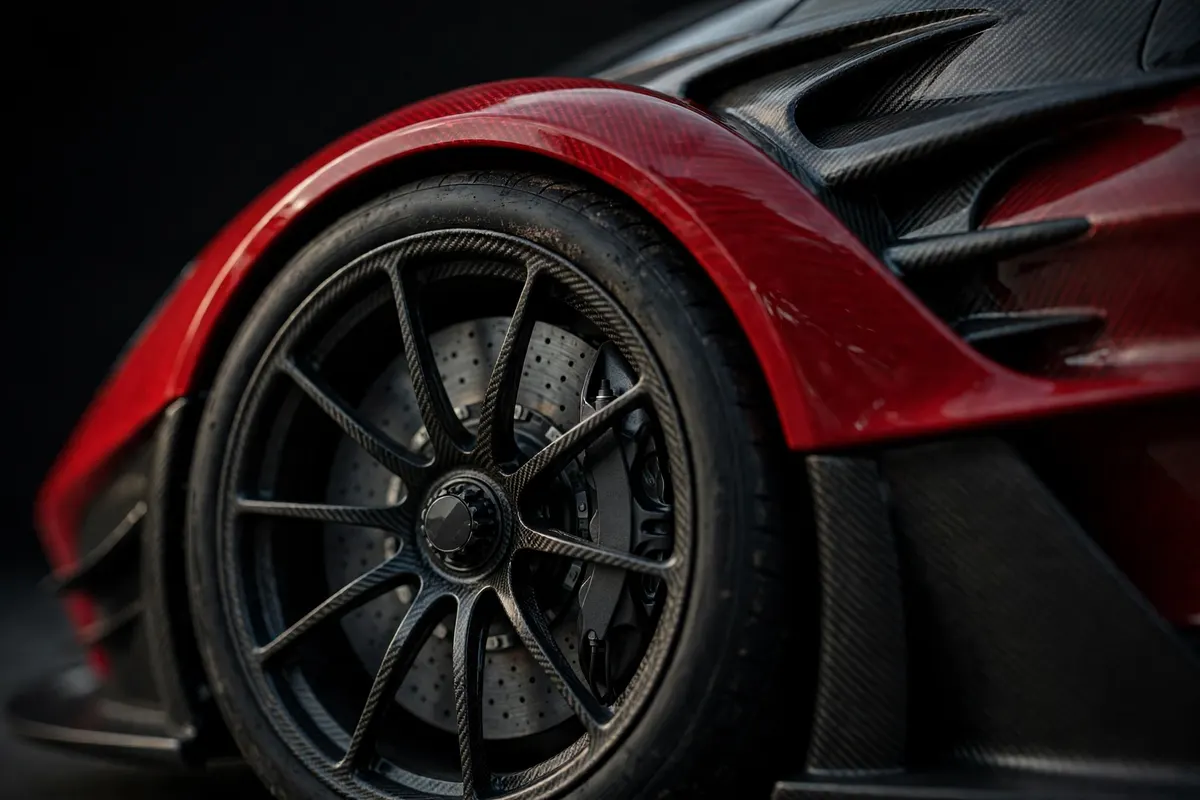
Four electric motors, one on each wheel, each rated at 555 kW and spinning to 30,000 rpm. Together they make 2,220 kW — 3,019 PS, or 2,977 horsepower — which makes the Yangwang U9 Xtreme the most powerful production car ever built. The motors run on a 1,200-volt architecture, the first mass-produced 1,200-volt system in a car, feeding a track-grade version of BYD's Blade Battery with lithium iron phosphate cells that can discharge at 30C. The e4 system drives each wheel independently, so the car can send power exactly where it is needed, and the DiSus-X fully active body control keeps the body flat when the car accelerates, brakes or turns. Stopping is handled by an enhanced titanium-alloy carbon-ceramic braking system, and the tyres are semi-slicks developed with Giti specifically for speeds above 500 km/h — prototypes of the tyre had already reached 311 mph in indoor testing by June 2025. The quoted power-to-weight ratio is about 1,200 horsepower per tonne, and the reported 0–100 km/h time is 2.36 seconds. There is no confirmed list price. The most solid number comes from the Beijing Auto Show in April 2026, where one car sold for more than CNY 20 million — about $3 million, which converts to roughly Rs 83 crore at the State Bank rate of Rs 276.82 to the dollar used in our earlier guides. That is a conversion, not a Pakistan price: there is no official price in Pakistan, and import duties and taxes here can double or triple a sticker price. For comparison, the standard U9 costs CNY 1.8 million in China, about $250,000.
Who held the record before? 📜
The record the Yangwang U9 Xtreme broke was its own. In September 2025, the same car reached 496.22 km/h (308 mph) at the ATP proving ground in Papenburg, Germany, with Marc Basseng driving — a run that already made it the fastest production car in the world. Before that, the title belonged to Bugatti for six years. On 2 August 2019, Bugatti test driver Andy Wallace took a Chiron Super Sport 300+ to 490.484 km/h (304.773 mph) at Volkswagen's Ehra-Lessien test track in Germany, making it the first production car ever to break 300 mph. Bugatti built 30 of them at about $3.9 million each, with a quad-turbo W16 making 1,578 hp. The 300 mph barrier had stood as the great wall of car speed for decades, and Bugatti's run was the moment it fell. The Yangwang U9 Xtreme has now pushed the mark 12.69 km/h further, and past a round number — 500 km/h — that no production car had ever touched. The jump from Bugatti to BYD is also a changing of the guard: the fastest production car in the world is no longer a petrol W16 from France, but a battery-electric car from China, built by the world's biggest EV maker.
Yangwang U9 Xtreme vs Bugatti, Rimac and Koenigsegg ⚔️
The Yangwang U9 Xtreme is the fastest production car ever measured, but the word fastest needs care, because not every record is measured the same way. The U9 Xtreme's 503.17 km/h is a single-direction peak, recognised by the FIA and Guinness for that category. The SSC Tuatara still holds the verified two-way average record — 455.3 km/h (282.9 mph), set on a closed Nevada highway in January 2021 — because a two-way average cancels out wind and slope, and BYD chose not to attempt one. The Rimac Nevera, the electric record holder before the Yangwang U9 Xtreme, is verified at 412 km/h (258 mph) with 1,914 hp from four motors, and it is also the quickest accelerating production car ever at 1.74 seconds to 60 mph. The Koenigsegg Jesko Absolut is the car that could, on paper, beat them all: Koenigsegg's own calculations put its theoretical top speed at about 531 km/h (330 mph) from a 1,600 hp twin-turbo V8, but it has never done a verified top-speed run. Hennessey's Venom F5 is built to chase 500 km/h too, but it has not verified a run at that speed either. So the honest table reads like this: the Yangwang U9 Xtreme owns the highest verified single-direction speed, the Tuatara owns the highest verified two-way average, the Nevera owns the electric acceleration records, and the Jesko Absolut owns the biggest unproven number. The car that wins depends on which rulebook you use — and on the only rulebook that has actually been run at 500 km/h, the Yangwang U9 Xtreme is alone.
Honest limits and trust questions ⚠️
A few things to know before you believe the poster, stated plainly. First, 503.17 km/h is a one-way peak on a closed road, not a speed you can use: it was set on a 10-kilometre stretch of empty highway with a 7-kilometre straight, on semi-slick tyres made for the job, with the road cleared of debris first. Your road car, on normal tyres, on a normal road, cannot do this, and the E11's normal speed limit is 160 km/h. Second, BYD's announcement said the run earned four Guinness World Records, but the FIA's announcement lists two for this run — the production car and electric production car single-direction records — so count two, not four. Third, this is a track-focused car: only 30 will be built, sold by invitation in China, and there is no confirmed list price — the $3 million figure comes from one car selling for over CNY 20 million, not from a published price list. Fourth, days before the Abu Dhabi run, photos showed a U9 Xtreme damaged after leaving its line on a closed track in China; BYD has not confirmed what test it was doing, and claims that it crashed while setting a record should not be believed. Fifth, the standard U9 listings you may see in Pakistan, at around PKR 8.5 crore, are for the standard car imported privately — not the Xtreme, which is a different car at roughly ten times the price. Finally, a record is a snapshot, not a promise: Koenigsegg still says the Jesko Absolut can do 531 km/h, and if it ever runs, the record moves again.
What this means for Pakistan 🇵🇰
There is no plan to bring the Yangwang U9 Xtreme to Pakistan — PakWheels reports exactly that, and the car is not listed for sale here or in most markets outside China. That is not a surprise: 30 cars, sold by invitation, at about $3 million, were never going to reach a Pakistani showroom. What does reach Pakistan is BYD itself: BYD sells its mainstream electric cars here through Mega Motor Company, which is building an assembly plant near Karachi, and the engineering in the Yangwang U9 Xtreme — the high-voltage platform, the Blade Battery, the four-motor control — is the same family of technology that filters down into the cars ordinary buyers can actually own. For a Pakistani car lover, the honest way to enjoy this record is to watch it: BYD's official channels and the FIA announcement carry the footage and the numbers, and more car stories on this blog cover the cars you can actually buy. The record matters here for a different reason: it is the clearest sign yet that the fastest car in the world is now electric, and the next one probably will be too.
Fastest production cars ever, verified
| Car | Top speed | Year | How it was measured |
|---|---|---|---|
| Yangwang U9 Xtreme | 503.17 km/h | 2026 | Single-direction run, FIA and Guinness recognised |
| Yangwang U9 Xtreme | 496.22 km/h | 2025 | Papenburg, Germany, single-direction run |
| Bugatti Chiron Super Sport 300+ | 490.48 km/h | 2019 | Ehra-Lessien, first production car over 300 mph |
| SSC Tuatara | 455.3 km/h | 2021 | Two-way average, Guinness verified |
| Rimac Nevera | 412 km/h | 2023 | Verified top speed, fastest EV before the U9 Xtreme |
| Koenigsegg Jesko Absolut | About 531 km/h | 2020 | Theoretical only, never verified in a run |
Yangwang U9 Xtreme vs the standard U9
| U9 Xtreme | U9 (standard) | |
|---|---|---|
| Power | 2,220 kW (2,977 hp) | 960 kW (1,287 hp) |
| Motors | 4 × 555 kW, up to 30,000 rpm | 4 × 240 kW |
| Top speed | 503.17 km/h (record) | 309.19 km/h |
| Production | 30 units, by invitation | Mass production in China |
| Price in China | Over CNY 20 million (one sale) | CNY 1.8 million |
Frequently asked questions
What is the Yangwang U9 Xtreme top speed?
503.17 km/h (312.66 mph), set on 1 November 2026 on the closed E11 highway in Abu Dhabi. It is the highest speed ever recorded by a production car, and the first time any production car has gone past 500 km/h.
When did the Yangwang U9 Xtreme set the record?
On 1 November 2026, on its second run of the second day of testing. The FIA announced its recognition on 6 November 2026, and Guinness World Records awarded two records for the run.
Is the Yangwang U9 Xtreme the fastest car in the world?
It is the fastest production car ever measured in a single-direction run. The SSC Tuatara still holds the verified two-way average record at 455.3 km/h, because the Yangwang U9 Xtreme did not attempt a two-way run.
What record did the U9 Xtreme break?
Its own: 496.22 km/h, set at Papenburg in Germany in September 2025. Before that, the Bugatti Chiron Super Sport 300+ held the mark at 490.484 km/h since August 2019.
How much power does the Yangwang U9 Xtreme have?
2,220 kW, or 3,019 PS (2,977 hp), from four electric motors of 555 kW each, one per wheel, spinning to 30,000 rpm on a 1,200-volt system. It is the most powerful production car ever built.
How much does the Yangwang U9 Xtreme cost?
There is no confirmed list price. One car sold for more than CNY 20 million at the Beijing Auto Show in April 2026 — about $3 million, or roughly Rs 83 crore at Rs 276.82 to the dollar, before any import duties.
How many Yangwang U9 Xtreme cars will be built?
Only 30, sold by invitation in China. The standard Yangwang U9 is the mass-produced car; the Xtreme is the limited track version.
Is the Yangwang U9 Xtreme road legal?
It is a track-focused car, and the record was set on a closed road with semi-slick tyres made for 500 km/h. It is not a car you can drive at that speed on a public road, anywhere.
Is the Yangwang U9 Xtreme available in Pakistan?
No. There is no confirmed plan to launch it in Pakistan, and Yangwang is not sold here. The standard U9 listings in Pakistan are private imports of the standard car, not the Xtreme.
What is the difference between the Yangwang U9 and the U9 Xtreme?
The standard U9 has 960 kW (1,287 hp), a 309.19 km/h top speed and a CNY 1.8 million price in China. The Xtreme has 2,220 kW, a 503.17 km/h record, track hardware throughout, and only 30 will be built.
How fast is the Rimac Nevera compared to the U9 Xtreme?
The Nevera is verified at 412 km/h, about 91 km/h slower than the Yangwang U9 Xtreme's 503.17 km/h. It was the fastest electric production car before the U9 Xtreme, and it is still the quickest accelerating production car ever.
Will the Koenigsegg Jesko Absolut go faster?
On paper, yes: Koenigsegg calculates about 531 km/h for the Jesko Absolut. But it has never done a verified top-speed run, so until it does, the Yangwang U9 Xtreme holds the verified record.